
National Fire Service Day 2026 - History and Theme
This blog is related to National Fire Service Day 2026, which is falling on 14th of April. Also, Fire Safety week is celebrated form 14th to 20th April 2026. As fire safety is everyone's responsibility let us take collaborative efforts to make school, hospital, home, and workplaces safe and free from fire incidents
Ganpat Shinde
4/4/20263 min read
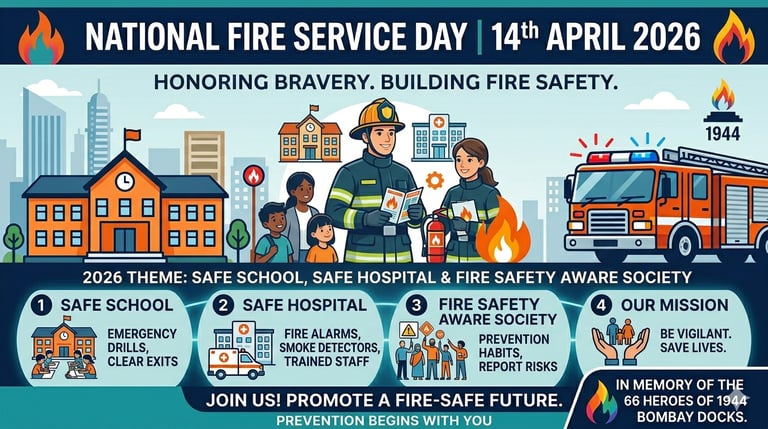
Every year on April 14, India observes National Fire Service Day. It is a day of deep reflection, immense gratitude, and a renewed commitment to safety. While we often see fire engines racing through traffic with sirens blaring, this day reminds us of the history and the heroes behind the uniform.
The History: Why April 14?
The origin of this day traces back to a tragic and heroic event in 1944. On this day, a massive fire broke out on the ship SS Fort Stikine at the Victoria Dock in Mumbai. The vessel was carrying a lethal combination of cotton bales, oil, and over 1,400 tons of explosives.
As the fire grew, the explosion was so powerful it shattered windows miles away. In the line of duty, 66 brave firefighters sacrificed their lives to prevent even greater destruction. National Fire Service Day (also known as Martyr’s Day) commemorates their bravery and the sacrifice of all firefighters who have fallen in the line of duty.
The Theme for 2026
The official theme for National Fire Service Day/Week 2026 is:
"Safe School, Safe Hospital & Fire Safety Aware Society – Together Fire Prevention"
(Hindi: सुरक्षित स्कूल, सुरक्षित अस्पताल और अग्नि सुरक्षा जागरूक समाज - साथ मिलकर अग्नि रोकथाम)
This year's theme shifts the focus from general industrial safety to specific high-occupancy environments (schools and hospitals) where the risk to life is highest, emphasizing that fire prevention is a collective social responsibility.
How to Build a Fire-Safe Environment
Fire safety is a mindset, not just a set of equipment. Here are the essential steps to ensure your home, school, society and workplace remain secure:
1.Safe School: Protecting the Next Generation
In a school setting, fire safety isn't just about the equipment; it's about the habit of safety among students and staff.
Evacuation Drills: Schools must conduct "Unannounced Drills" to test the reaction time of students. The goal is to make the exit route a muscle memory for every child, regardless of where they are in the building.
Electrical Audits: Most school fires originate in labs or computer rooms. Regular thermal scanning of electrical panels is essential to catch overheating before it sparks.
Kitchen & Canteen Safety: For schools with mid-day meal programs or canteens, gas leak detectors and automatic shut-off valves are critical.
The "Safety Teacher" Role: Designating fire marshals among the teaching staff ensures that in a panic, there are trained adults to lead students away from smoke and heat.
2.Safe Hospital: The Challenge of Limited Mobility
Hospitals are the most difficult environments to secure because many occupants (patients) cannot move without assistance.
Vertical vs. Horizontal Evacuation: Since moving patients down stairs is slow, hospitals prioritize "Defend in Place" or "Horizontal Evacuation"—moving patients behind fire-rated doors to a different smoke compartment on the same floor rather than exiting the building immediately.
Oxygen Safety: Hospitals have high concentrations of oxygen, which acts as a powerful accelerant. Strict "No Smoking" zones and leak detection systems for oxygen lines are life-saving.
Electrical Life-Support: Fire systems must be integrated so that if power is cut during a fire, critical life-support systems (Ventilators, ICU monitors) transition seamlessly to fire-protected backup circuits.
Staff Training (R.A.C.E.): Hospital staff are trained in the R.A.C.E. protocol:
Rescue anyone in immediate danger.
Alarm (Pull the fire alarm).
Contain the smoke (Close doors).
Extinguish or Evacuate
3.At Residence/Home
Kitchen Safety: Never leave cooking unattended. Keep flammable items like towels and curtains at least three feet away from the stove top
Install Smoke Alarms: Place alarms on every floor of residence. Test them monthly and replace batteries annually.
The 3-Foot Rule: Keep space heaters or candles at least three feet away from anything that can burn (bedding, rugs, or paper).
Escape Plan: Ensure every family member knows two ways out of every building or apartment and designate a safe meeting spot outside.
4.In the Workplace
Clear the Path: Never block fire exits, even "just for a minute." Ensure escape routes are well-lit and free of clutter.
Know Your Extinguisher: Don't wait for an emergency to read the instructions. Remember the PASS method: Pull the pin, Aim at the base, Squeeze the handle, and Sweep side-to-side.
Electrical Vigilance: Avoid overloading power sockets and replace any frayed or damaged cords immediately. Most office fires start with faulty wiring.
Conduct Drills: Participation in fire drills helps build "muscle memory," ensuring everyone stays calm and knows exactly where to go during a real emergency.
Our Pledge
Safety is not a checklist we complete once a year; it is a habit we practice every day. This National Fire Service Day, let us honor the martyrs of the 1944 Bombay Dock explosion not just with words, but with action.
Fire prevention begins with you. Take a moment today to check your smoke alarms, locate your nearest exit, and thank a firefighter for their selfless service.
"Fire service is a calling. Fire prevention is a responsibility."